Samsung vs Apple in Singapore — Which Should You Actually Buy?
Two phones. Both flagship. Both expensive. Both marketed as the best thing you can put in your pocket. The Samsung Galaxy S26 series and the iPhone 16 series are the two dominant choices for anyone spending serious money on a phone in Singapore right now, and the honest answer to which is better is not as clean as either brand would like you to believe.
Here is a straightforward comparison across the things that actually matter when you are spending SGD 1,400 to 2,000+ on a phone.
Price — What You Actually Pay in Singapore
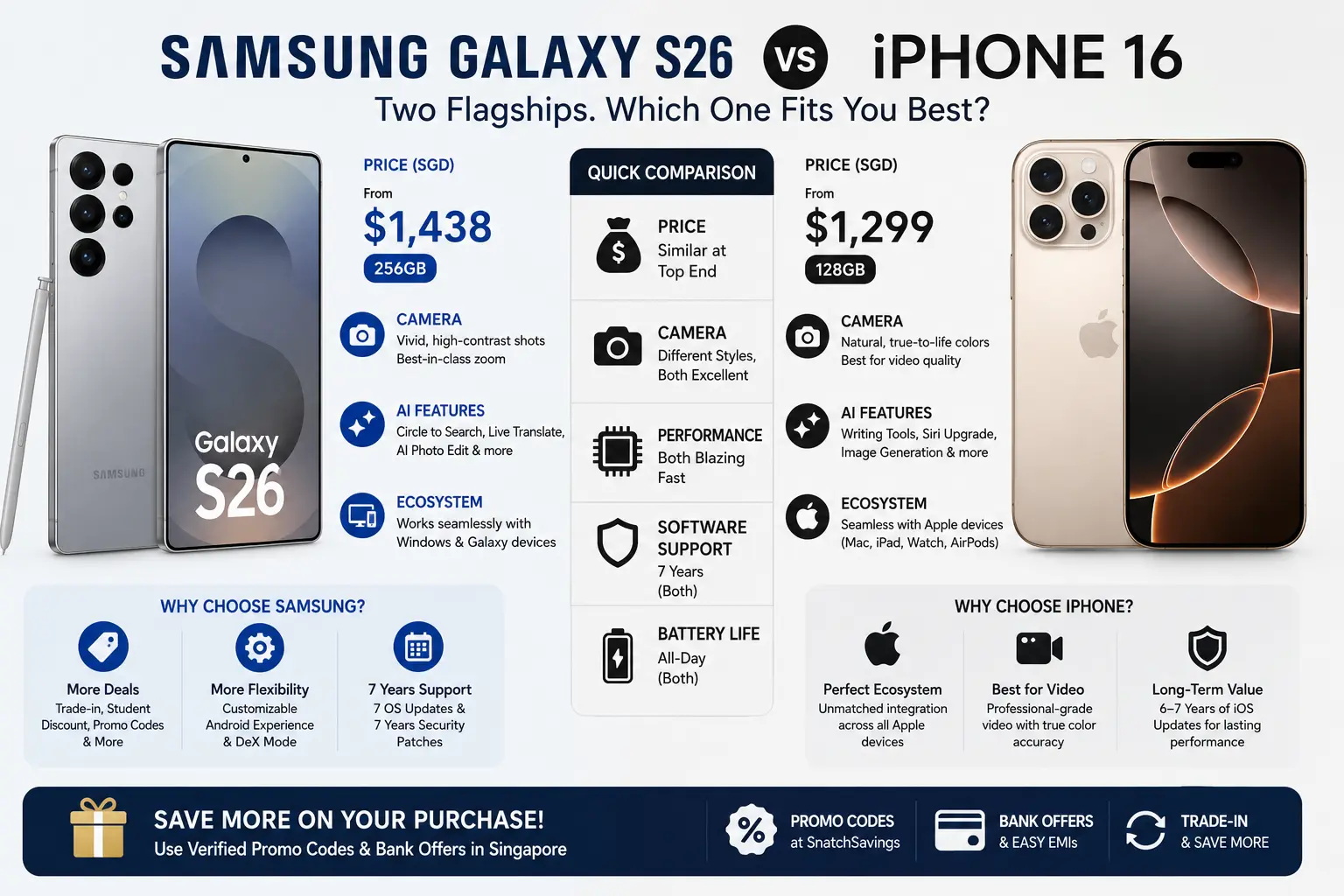
Galaxy S26 starts at SGD 1,438 for 256GB. iPhone 16 starts at SGD 1,299 for 128GB — slightly cheaper entry point but the storage is half. To get 256GB on an iPhone 16, you are at SGD 1,449, which is almost exactly the same starting price as the S26.
At the top end, Galaxy S26 Ultra at 1TB is SGD 2,368. iPhone 16 Pro Max at 1TB is SGD 2,399. Essentially identical for maximum storage flagships from both brands.
Where Samsung has a practical edge on price is the ecosystem of deals available in Singapore. The trade-in programme, student discount of up to 20%, Super Brand Day events on Lazada, and the availability of verified promo codes through platforms like SnatchSavings give Samsung buyers more legitimate ways to reduce the final price. Apple's pricing in Singapore is consistent and offers fewer discount routes outside of trade-in.
Camera — The Real Comparison
Both phones have excellent cameras. The argument that one is simply better than the other oversimplifies what is actually a preference question.
Samsung's cameras produce vivid, high-contrast images that look striking immediately out of the camera. The zoom capability on the S26 Ultra is technically impressive — the hardware optical zoom range is one of the best on any smartphone available right now.
Apple's cameras produce images that are more neutral and closer to what the human eye actually sees. iPhone videos, in particular, have a consistency and colour accuracy that has made them the choice for professional videographers who shoot on mobile.
For social media use and photography where the image is viewed on a screen, Samsung's processing often makes photos look immediately impressive. For printing, professional work, or long-term archiving, iPhone's more natural colour science holds up better.
Neither is wrong. They are optimised for different aesthetics.
Ecosystem — The Biggest Practical Difference
This is where the decision is actually made for most people, and it is worth being direct about it.
If you have a Mac, iPad, AirPods, and Apple Watch — switching to Samsung means leaving behind a level of device integration that Android simply cannot fully replicate yet. AirDrop, Handoff, iMessage syncing, Universal Clipboard — these work seamlessly between Apple devices in a way that the cross-device experience on Android and Samsung's Galaxy ecosystem does not yet match for ease.
If you are on Windows, do not own other Apple products, and are not deeply embedded in the Apple ecosystem — Samsung is the more practical choice. Galaxy's integration with Windows laptops, the DeX desktop mode, and the broader flexibility of Android as an operating system give Samsung users more control over how they use their device.
The ecosystem question should be your first filter. If you are already in Apple's world and it works well for you, there is no compelling technical reason to leave it. If you are not, Samsung gives you more for the money.
AI Features — Both Are Leaning In Hard
Samsung Galaxy AI and Apple Intelligence are both significant focuses for their respective flagships. Samsung's AI features include on-device translation, Circle to Search, AI-generated summaries, and photo editing tools that remove and reconstruct backgrounds. Apple Intelligence brings writing tools, improved Siri, image generation, and deep app integration.
In practical daily use, Samsung's AI features tend to be more visible and more frequently used — Circle to Search alone is something Galaxy users mention consistently as a feature they did not know they needed. Apple's AI integration is more subtle and more tightly woven into existing workflows rather than presented as separate features.
Neither company's AI is transformative in a way that should determine your purchase decision alone. Both are iterating and the gap between them will narrow with each software update regardless of which phone you buy.
Longevity and Software Support
Apple provides software updates for six to seven years on its devices. If you bought an iPhone 16 today you could reasonably expect it to be updated until 2031.
Samsung has extended its commitment significantly — the Galaxy S26 series is promised seven years of OS updates and seven years of security patches, matching Apple's support timeline for the first time.
This is a meaningful change for Samsung. Previously, Apple's longer support lifecycle was a genuine reason to justify the iPhone's price premium for buyers thinking about the long term. That argument is now weaker than it was.
Which Should You Buy in Singapore?
Buy Samsung if you are on Windows, do not use other Apple products, want more ways to reduce the purchase price, prefer a more customisable Android experience, or shoot primarily photos for social media where Samsung's processing style suits the format.
Buy iPhone if you are already embedded in the Apple ecosystem and it is working well for you, shoot video professionally or semi-professionally, or prioritise the seamless device-to-device experience across Apple products.
There is no universal right answer. Both are excellent phones. The practical decision comes down to your existing ecosystem, how you use your camera, and whether the available Samsung deals in Singapore change the value calculation enough to tip the balance.
Find verified Samsung promo codes at SnatchSavings Singapore - updated daily.
Frequently Asked Questions
At equivalent storage levels, the prices are very close. Samsung has more routes to discount the final price — trade-in programme, student discount, Super Brand Day events, and promo codes — which makes the effective price often lower than iPhone's more fixed pricing.
Samsung Smart Switch makes the data transfer straightforward. The adjustment period is mainly around app availability and ecosystem differences — iMessage, AirDrop, and Apple-specific services do not transfer. For users without deep Apple ecosystem ties, the switch is manageable within a week.
Samsung's processing tends to produce more vivid, immediately appealing food photos for social media. iPhone produces more natural colour, which some prefer for longer-form content or professional work. For hawker centre food shots destined for Instagram, Samsung's default output is typically the more striking result.
Trade-in values vary by device model and condition on both platforms. Samsung's current promotion offers up to SGD 890 off the S26 Ultra with an eligible trade-in, which is competitive. Apple's trade-in values tend to be consistent but conservative. Compare both using your specific device before deciding.
SnatchSavings maintains daily-verified Samsung Singapore discount codes. Applying a working code at the Samsung online store is one of the simplest ways to reduce the Galaxy S26 purchase price.
About the Author

Rahul Verma
Rahul specializes in e-commerce trends and discount strategies to maximize your shopping experience. With 4+ years of experience, he provides expert insights on getting the best value for your money online.